Aechmea recurvata
About recurvata
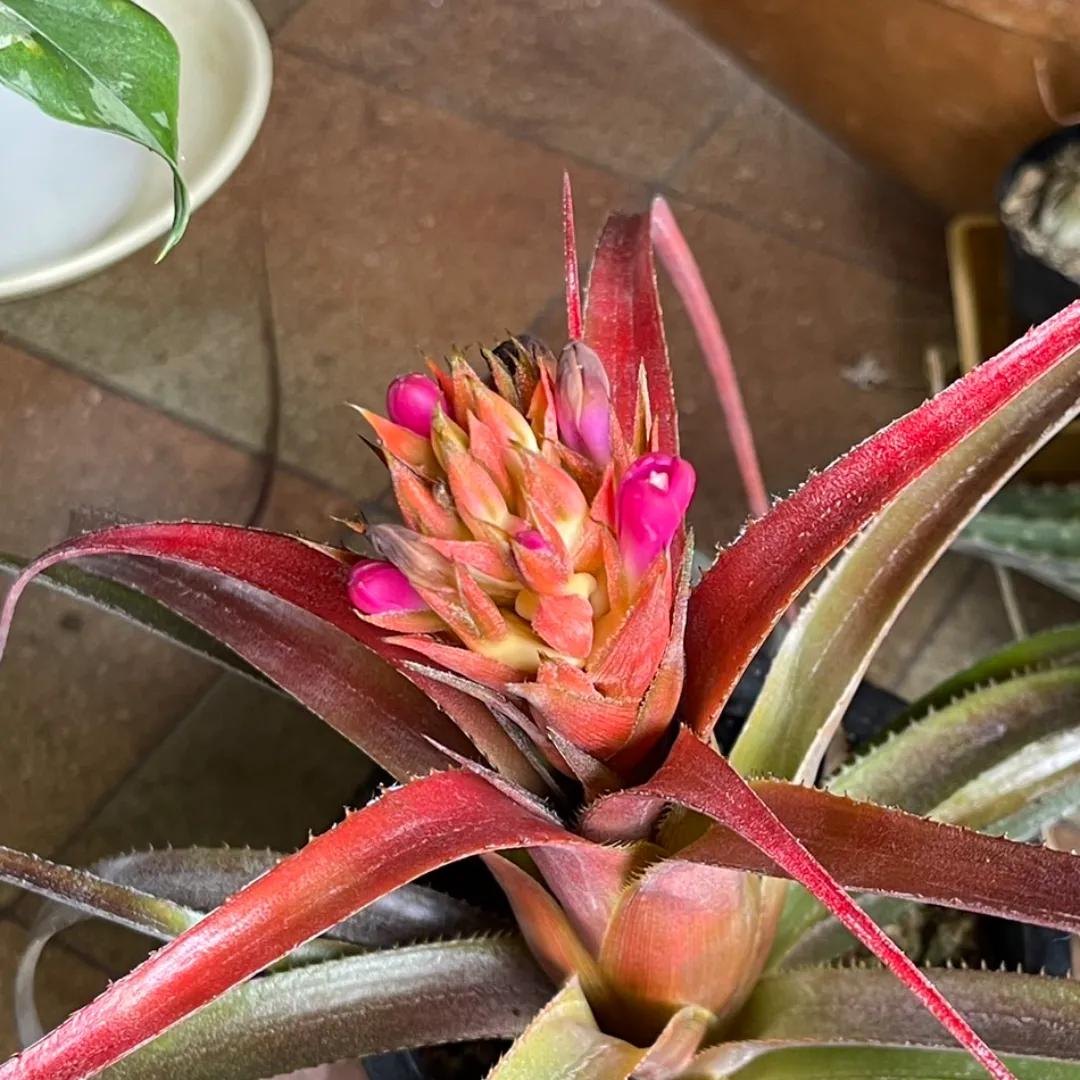
A compact bromeliad native to southern Brazil, Paraguay, Uruguay, and northern Argentina. This species grows as an epiphyte or on rocks in subtropical regions. It forms neat rosettes about 30-38cm wide with stiff, recurved leaves in glossy yellow-green. The leaf margins have small spine-like teeth. When blooming, the center turns vivid red while outer leaves become rose-colored, creating distinctive bicolor effects. The flowers feature bright orange-red bracts.
Care guide for エクメア(エクメア)
Aechmea属(エクメア)はブラジルを中心とした中南米原産のブロメリア科の着生植物です。筒状に重なる葉の中心に水を溜める「タンクブロメリア」の代表格で、鮮やかな花序が長期間楽しめます。
Frequently asked questions about Aechmea recurvata
- Why does the whole plant of Aechmea recurvata turn red when it flowers?
As the spring-to-summer flowering season approaches, the leaves at the center of the rosette turn red and the outer leaves blush rose, and a short inflorescence wrapped in red bracts opens pink to violet flowers. The coloring is a sign that the plant is ready to flower, not a symptom of disease or sunburn.
How strongly the plant colors depends largely on light. Plants grown in strong light stay compact with short leaves and color vividly, while plants in too little light produce long leaves that tend to stay green. Because full summer sun in Japan can scorch the leaves, some growers keep it under about 40 to 50 percent shade.
- Does the mother plant die after flowering? What should I do with the pups?
A rosette that has flowered will not flower again, but the mother plant of Aechmea recurvata does not decline right away and keeps its leaves and continues growing the following year. Cut off the spent inflorescence at its base.
Pups appear close to the mother plant, so if you leave them the clump grows larger every year. Growers overseas report two to five pups per plant per year, and some forms pup more readily than others. If you separate a pup, wait until it has five or six leaves. Pups removed too small may fail to root.
- How cold hardy is it, and how do I get it through winter?
Aechmea recurvata is among the hardier species of Aechmea. Growers overseas report that it tolerates direct frost down to about -5°C. Prolonged freezing damages it, though, so in Japan aim for a spot that stays above 0°C and move it under eaves or indoors in cold regions.
In winter, tip the pot to empty the tank (the water-holding leaf bases) and water only the potting mix once it has dried. Water left standing in the tank during cold weather makes the base prone to rot.
- How do var. benrathii and var. ortgiesii differ from the typical form?
Aechmea recurvata has three varieties. In the typical var. recurvata the inflorescence rises above the leaf bases and the bracts have toothed edges. In var. ortgiesii and var. benrathii the inflorescence stays sunken among the leaf bases. Plants with strongly toothed leaf and bract margins are var. ortgiesii, and those with nearly smooth margins are var. benrathii.
The species has been used as a parent of many hybrids, and unnamed seedlings are also in circulation. For a plant you cannot place by name, comparing the height of the inflorescence and the marginal teeth gives a good indication.
Growth Records of recurvata
1