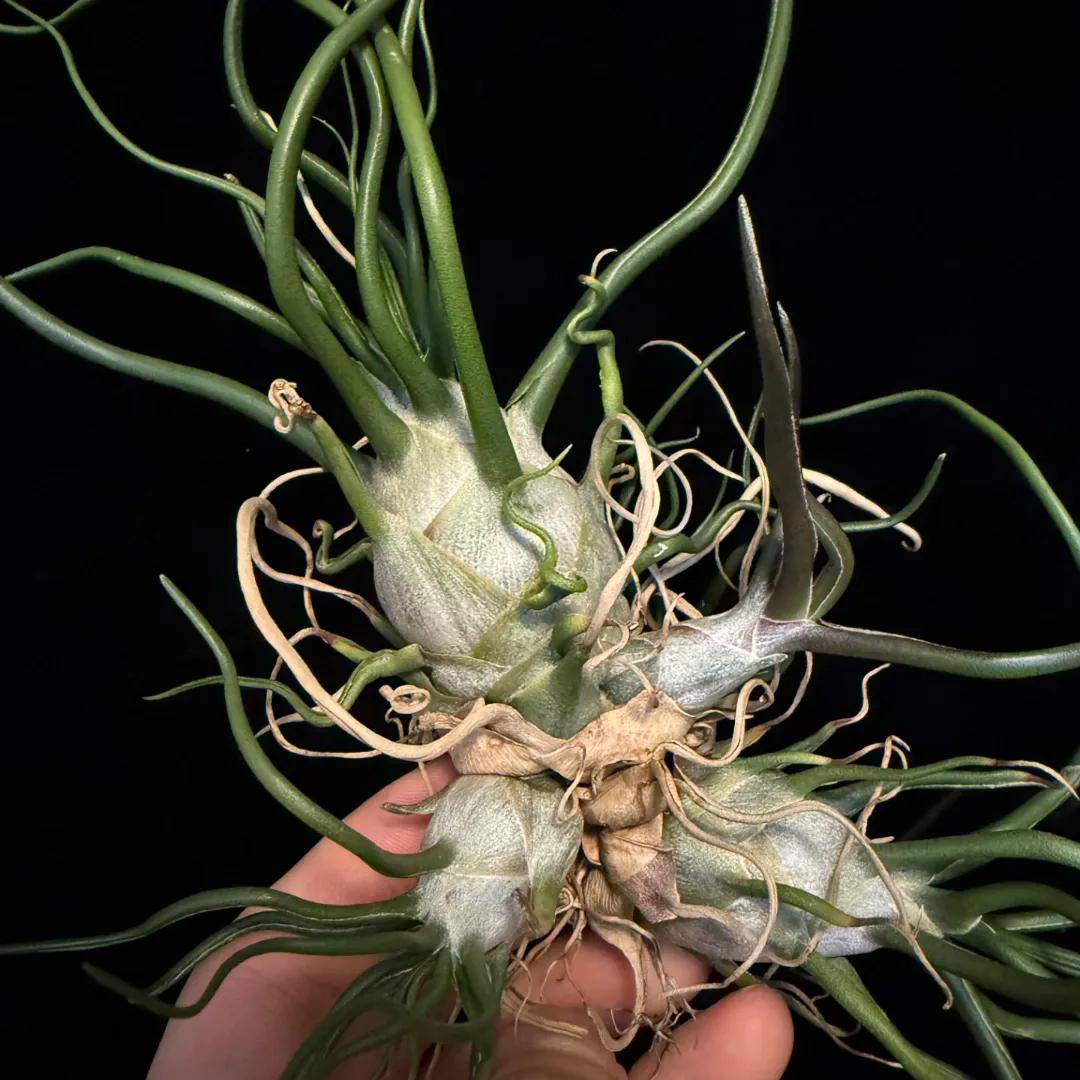
Tillandsia bulbosa
About bulbosa
A Tillandsia characterized by a bulbous pseudobulb base and long, twisted, tentacle-like leaves. Native to tropical regions from Mexico to Brazil, found in mangrove thickets, open woods, and along riverbanks. The swollen base often houses ant colonies in a mutualistic relationship—the ants provide nutrients while receiving shelter. Blooms with cherry-red bracts and violet tubular flowers. One of the few Tillandsias tolerant of higher humidity and lower airflow, making it suitable for terrariums.
Care guide for ティランジア(エアプランツ)
Tillandsia属(エアプランツ)は土を必要としない着生植物です。葉から水分を吸収するため、独特の管理方法が必要です。
What the guide covers
- ティランジアとは
- 水やりの方法
- 風通し
- 日光・置き場所
- 温度管理
- 肥料
- 飾り方・固定方法
- 着生について
- 発根について
- 板付けの方法
- 開花について
- 増やし方
- 日常のお手入れ
- よくあるトラブル
Frequently asked questions about Tillandsia bulbosa
- What is the bulb-shaped base of Tillandsia bulbosa for? Does it really involve ants?
The bulb-shaped base is formed by the greatly inflated, overlapping leaf bases (sheaths). It is not a true bulb. The inflated sheaths do not fit tightly against each other, which leaves hollow spaces between them. In the wild, ants nest in these spaces. The ants gain shelter, and the food scraps and waste they bring in become nutrients for the plant. Plants with this habit are called myrmecophytes, and a dozen or so Tillandsia species, including Tillandsia caput-medusae and Tillandsia butzii, are known to house ants.
In cultivation the plant does not need ants and grows normally without them. The bulb is not a water storage organ either, so there is no need to keep water inside it.
- How do I keep water out of the bulb? What should I watch for when watering?
Water that gets between the inflated leaf sheaths drains poorly, and if it sits there for long the plant rots from the inside and the central leaves pull out. After soaking, turn the plant upside down and shake it to empty the bulb, then hang it upside down or lay it on its side in moving air so it dries within a few hours. It is fine to grow the plant upside down or sideways permanently.
Tillandsia bulbosa is a green-leaved (mesic) species with few water-catching trichomes on its leaves, so it dries out faster than silver-leaved species, yet it cannot store water. Cutting back on long soaks and relying on misting a few times a week keeps humidity up without leaving water in the bulb. In dry air the leaves twist more tightly.
- When does Tillandsia bulbosa flower, and what happens to the plant afterward?
There is no fixed season. The plant flowers once it has grown large enough. As flowering approaches, the upper leaves and bracts turn red, and a short stalk carries two to five flattened spikes from which tubular blue-violet flowers 3 to 4 cm long open in turn, with the stamens and style extending beyond the petals. The red fades gradually after the flowers finish.
Each plant flowers only once in its life. Afterward it stops producing new leaves and slowly declines while producing pups. If you want to separate a pup, wait until it is about half the size of the mother and has at least five or six leaves. Left attached, the pups form a clump of bulbs side by side.
- How do I get Tillandsia bulbosa through winter? What is the minimum temperature?
Tillandsia bulbosa is damaged by frost, so in most of Japan it is brought indoors for winter. Keep it above 10°C, and ideally on a bright windowsill that stays above 12°C.
Once the nightly low drops below 10°C, cut watering back to about once a week and water in the morning on a mild day. Plants dry more slowly in winter, so always turn the plant upside down afterward to drain the bulb and make sure it is dry by nightfall. Keep it out of the direct blast of heaters, which dries it out too much.
Growth Records of bulbosa
2
