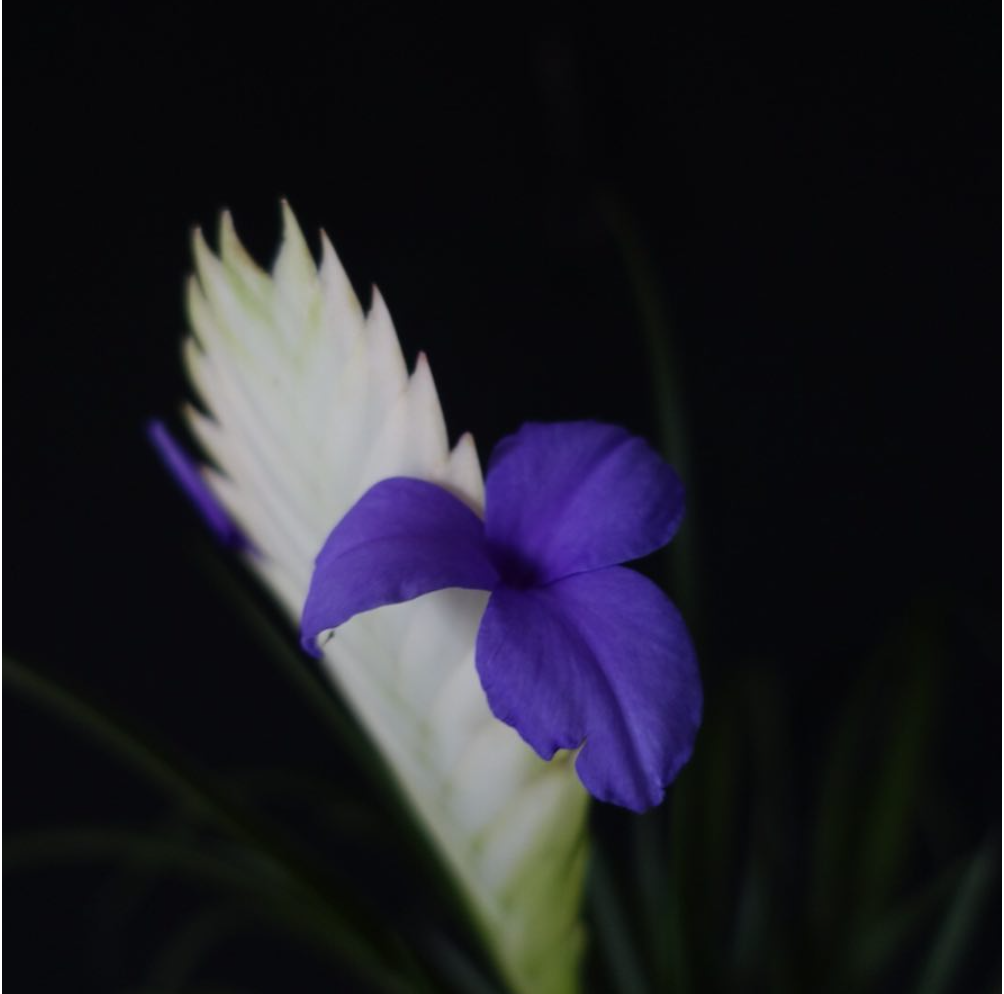
Wallisia cyanea
About cyanea
A medium-sized epiphytic bromeliad forming stemless rosettes up to 50 cm wide. The narrow, recurved leaves are dark green with reddish-brown striations at the base. The distinctive paddle-shaped inflorescence features densely packed rose-pink bracts up to 16 cm long, from which fragrant violet-blue flowers emerge successively. The species name "cyanea" refers to the deep blue color of the flowers. Formerly classified as Tillandsia cyanea, it was reassigned to Wallisia in 2016 based on phylogenetic analysis.
Frequently asked questions about Wallisia cyanea
- How are the pink part and the blue flowers related, and what do I do with the pink part after flowering?
The flat pink part is an inflorescence made of overlapping bracts (modified leaves that enclose the flowers), not the flowers themselves. The flowers emerge one at a time from between the bracts and open three violet-blue petals. Each flower fades within a few days, but the bracts stay colored until the last flower is finished, so the display lasts around a month.
Once the bracts fade and turn brown after the last flower, cut the inflorescence off at its base with scissors. A rosette that has flowered will not produce another inflorescence.
- Does the plant die after flowering? When should I separate the pups?
After flowering the mother plant produces two to four pups from the leaf axils and gradually declines as they grow. The plant itself is not lost, because the pups carry on even after the mother fades.
Separate a pup once it is one third to one half the size of the mother and pot it in sphagnum moss or bark. May to June, when growth resumes, is a good time. If you leave the pups attached, several rosettes form a cluster around the mother plant.
- How should I water it and get it through winter? Is it fine if it does not hold water between the leaves like Tillandsia?
Wallisia cyanea is a green-leaved epiphyte and, unlike silver-leaved Tillandsia, it also takes up water through its roots. So rather than mounting it or leaving it bare, grow it in a pot of sphagnum moss or bark chips. The leaves do not form a water-holding tank, so during the growing season water thoroughly when the surface of the mix begins to dry, and mist the leaves often.
A minimum of 7°C is the guideline for winter. Move the plant to a bright indoor windowsill before night temperatures drop below 10°C, and keep it out of the direct blast of heaters. Growth slows in winter, so keep the mix on the dry side and reduce misting to about twice a week. During cold spells avoid leaving water in the leaf bases, and if the room gets close to 5°C keep the pot drier still.
- Is it a different plant from Tillandsia cyanea?
It is the same plant. The species was formerly placed in Tillandsia and was sold for many years as Tillandsia cyanea. In 2016 a revision based on DNA analysis revived the genus Wallisia, which had been proposed in the 19th century, and Wallisia cyanea became the accepted name. The epithet cyanea means "blue" and refers to the flower color.
Confusingly, the name Tillandsia cyanea is now applied to a different species, the plant long known as Tillandsia guatemalensis. In garden centers and books, "Tillandsia cyanea" almost always means this Wallisia cyanea.
Types of cyanea
1
Growth Records of cyanea
1