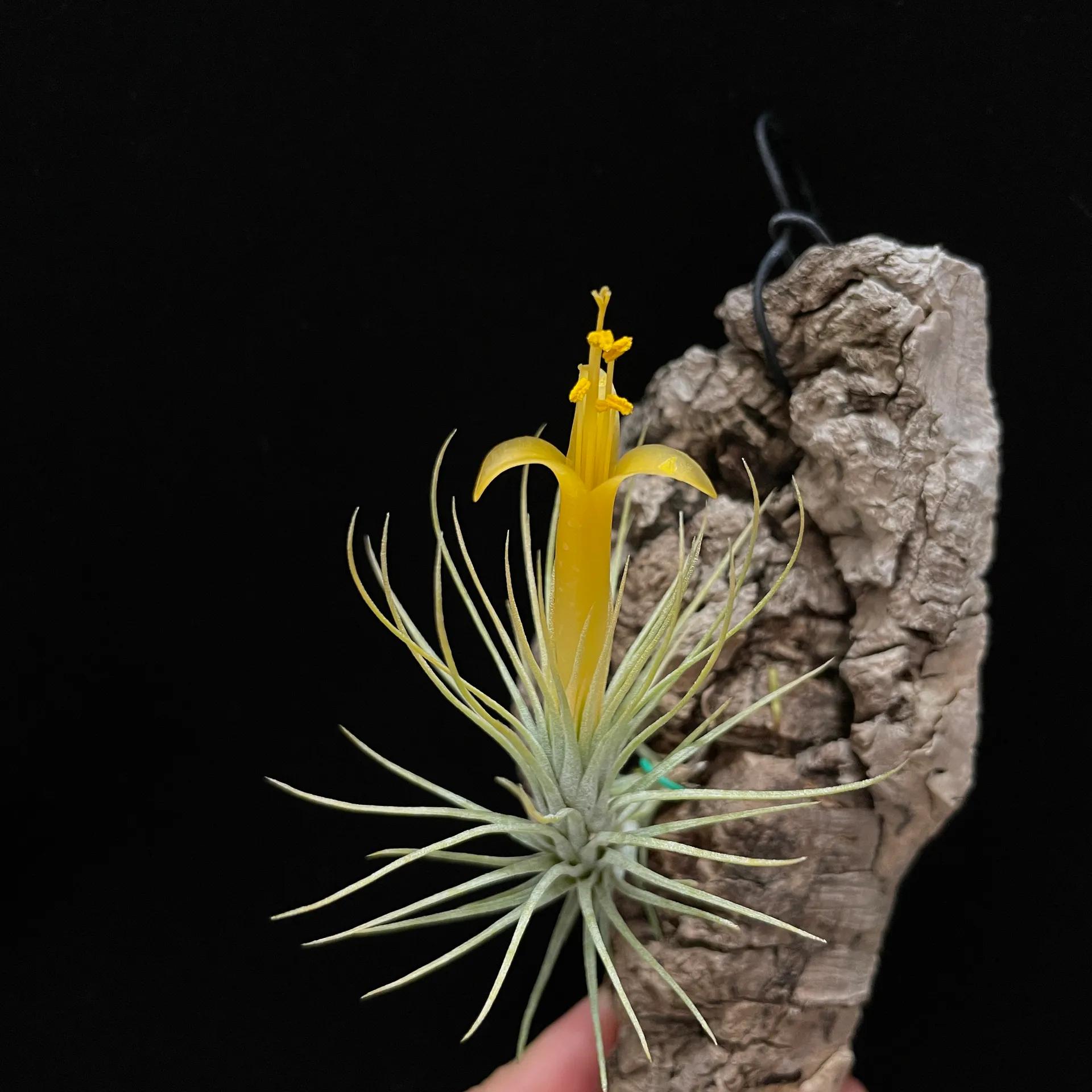
Tillandsia funckiana
About funckiana
Distinctive caulescent (stem-forming) air plant with needle-like leaves resembling small pine branches. Produces spectacular scarlet-red tubular flowers. Forms long, draping clumps over time. Named after Belgian botanist Nicolas Funck.
Care guide for ティランジア(エアプランツ)
Tillandsia属(エアプランツ)は土を必要としない着生植物です。葉から水分を吸収するため、独特の管理方法が必要です。
What the guide covers
- ティランジアとは
- 水やりの方法
- 風通し
- 日光・置き場所
- 温度管理
- 肥料
- 飾り方・固定方法
- 着生について
- 発根について
- 板付けの方法
- 開花について
- 増やし方
- 日常のお手入れ
- よくあるトラブル
Frequently asked questions about Tillandsia funckiana
- Is it normal for the stem of Tillandsia funckiana to keep getting longer?
Yes. Tillandsia funckiana is a caulescent (stem-forming) species. Needle-like leaves about 2.5 cm long are packed in a spiral around a thin stem only about 5 mm thick, and the growing tip keeps extending. Some clones grow straight and others twist as they grow. In the wild the plants branch and mass together on rock walls to form cushions.
The growing tip turns toward the light, so a plant mounted sideways or upside down will curve upward as it grows, and a hanging plant develops into a trailing cluster. In a dim room, however, the leaves space out and the stem becomes lanky, so tell normal stem growth apart from etiolation.
- When does the red flower appear, and what happens afterward?
There is no fixed season, and different clones flower at different times of year. As flowering approaches, the leaves near the tip of the stem blush red, and a single tubular scarlet flower (rarely two) opens at the tip. The petals are about 5 cm long, with the stamens and style extending beyond them. Red flowers are unusual in the genus Tillandsia, and in the wild the flowers are pollinated by hummingbirds.
The flower lasts several days, and a stem that has flowered stops extending. The plant carries on through the pups that emerge along the stem and at the base. The species is self-incompatible, so seed can only be obtained by crossing plants of different clones.
- Where do the pups form, and should I separate them?
Pups form not only at the base but also partway along the stem. The plant produces pups even without flowering, and it is common for pups to start growing before the mother plant blooms, so a single plant readily builds into a clump.
Leaving the pups attached is the easier option. The stems branch into a cluster and several flowers appear together at bloom time. If you do separate a pup, wait until it is about half the size of the mother and has enough leaves of its own to take up water.
- I heard Tillandsia funckiana is sensitive to cold. How do I get it through winter?
Tillandsia funckiana is among the more cold-sensitive members of the genus. It is easily damaged by nights below 4 to 5°C and can die if temperatures stay at 5°C or lower. Bring it indoors before the nightly low drops below 10°C and keep it on a bright windowsill that stays above 10°C, moving it in earlier than your other species.
In the cold months water less and keep the plant on the dry side, which improves its cold tolerance. Watering at night in an unheated room chills the plant, so water in the morning on a mild day and let it dry by nightfall.
Growth Records of funckiana
1